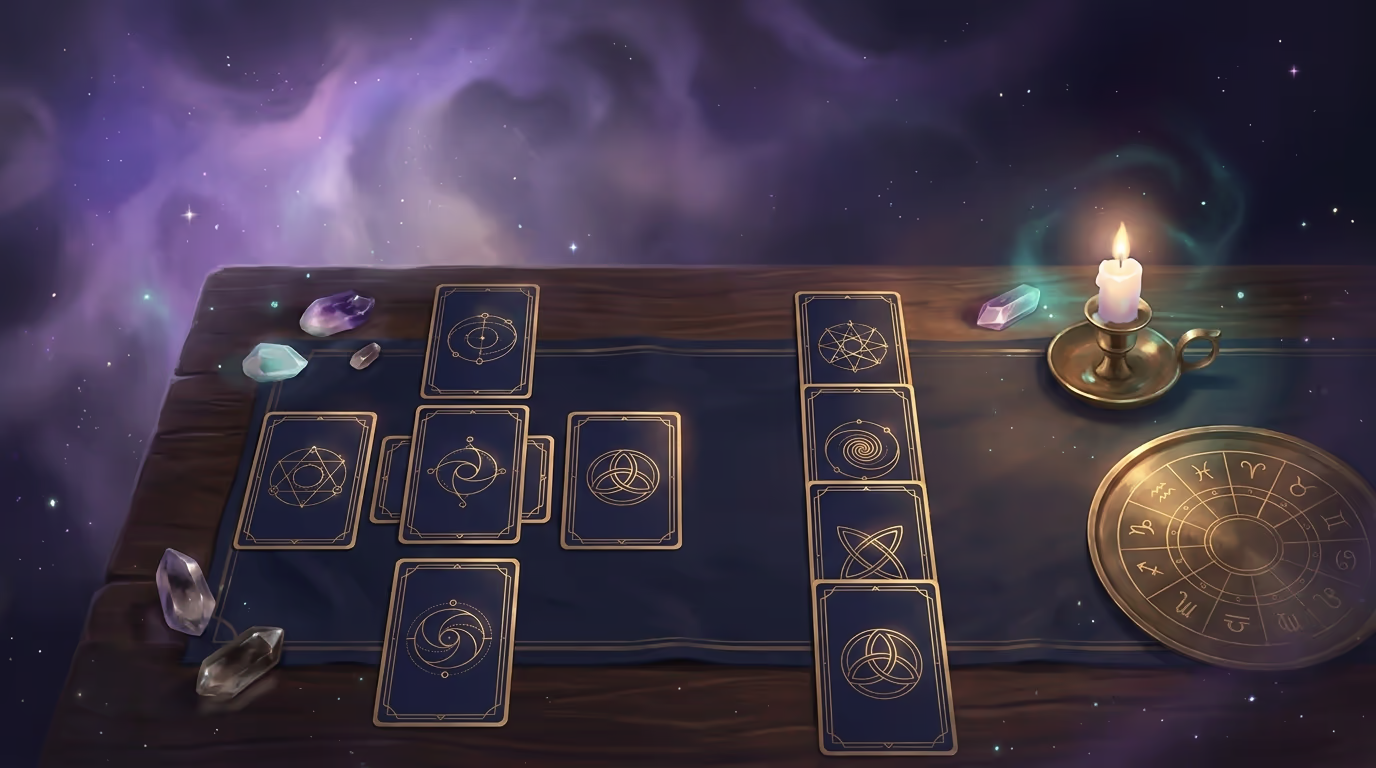
The Celtic Cross is a spread that can feel intimidating at first. Ten cards, an odd layout on the table, lots of details. At the same time this is the spread that keeps showing up in tarot books and YouTube videos.
Tarot is traditionally associated with big questions. The Celtic Cross reflects that well because it shows not only an answer but also context, tension, resources and possible directions. It works more like a map than a simple yes or no sign.
If you usually work with simple spreads, for example three cards or a quick one card question in /sanctuary/tarot, the Celtic Cross can be a natural next step. It is possible to learn it even with a first deck and a first tarot journal.
In short: The Celtic Cross is a classic 10 card spread that gives a full picture of a situation: present, past, future and your resources. The instructions are simple: first set your question, then lay the cards in a specific order, following the layout on the table. Each position has its own meaning. Interpretation comes from connecting cards into axes: time, tension and support. In the end you get not a verdict but a scenario that you can consciously co create.
1. The Celtic Cross: what this spread is and what it is really for
A tarot classic. The Celtic Cross is one of the oldest and most popular spreads in the tarot tradition. Arthur Edward Waite described it in the early 20th century. There is no evidence that it has anything to do with historical Celts. The name is marketing, not historical fact.
A spread for bigger topics. The Celtic Cross works best when the question concerns a complex situation. For example:
- a relationship where a lot is happening at once
- a job change or a shift in career direction
- moving, changing country, major life decisions
- a long term conflict that has been going on for months or years
Instead of a short yes or no, the Celtic Cross shows how the situation develops, what drives it, where the blocks are and what options are available.
A map, not a sentence. Traditional tarot can be quite fatalistic. Modern practice, including in Zorynthia, treats the Celtic Cross as a tool for reflection. The card in the future position is not a sentence. It shows the most likely scenario if nothing in your approach changes.
To see how this attitude works in practice, read about how tarot affects life. There the cards are also treated more like a conversation than a prediction.
2. When to use the Celtic Cross and when a simpler spread is better
Choose the Celtic Cross when:
- the topic has many layers and is emotionally important
- there is a sense of standing at a crossroads, without clarity where exactly
- the goal is to see context, not only what will happen
- there is at least 20 to 30 minutes of quiet time for the spread
Stay with simpler spreads when:
- the question is very specific, for example “What is the best thing to do this week about X” (here a 3 card spread or a quick question in /sanctuary/tarot is usually enough)
- you are just getting to know the deck and still get lost in meanings
- there is no time for notes and calm reflection
A good practice for beginners. At the beginning use the Celtic Cross for only 1 or 2 important questions per month. For other topics choose simpler layouts. This way you do not overload yourself with information and you are less likely to give up after the first attempts.
3. How to prepare: question, deck, space, notes
1. The question:
Open but concrete questions work best. Instead of “Will he come back”, try questions like “What do I need to understand about this relationship and my role in it” or “What course of action will strengthen me the most in this situation”.
Avoid questions about health, diagnoses and legal matters. Tarot, including in Zorynthia, is entertainment and inspiration for reflection, not a medical, legal or financial tool.
2. The deck:
At the beginning a classic style deck works best, for example inspired by Rider Waite Smith. The imagery is clear and rich in symbols. In Zorynthia you can browse different tarot decks and choose one that does not visually exhaust you.
If you use a physical deck, shuffle it calmly a few times. If you use /sanctuary/tarot, the app draws the cards for you, but still take a moment to focus.
3. The space:
You need a piece of table or floor that fits ten cards in two groups: the cross and the column. Create basic order: turn off notifications, move your laptop aside, prepare a notebook or notes app.
4. Notes:
Write down the question, the date and a short list of cards with their positions. This makes it possible to return to the spread in a week or a month and see what mirrored reality closely and what worked more as metaphor.
4. Laying the cards step by step: the order of 10 positions and the layout on the table
There are several variants of the Celtic Cross. This guide describes the most common one, also used in many virtual spreads.
Imagine a table. On the left side you build a cross of six cards. On the right you build a vertical column of four cards.
Card order:
- Card 1: center of the cross, at the bottom
- Card 2: laid across card 1, horizontally
- Card 3: above card 1
- Card 4: below card 1
- Card 5: to the left of card 1
- Card 6: to the right of card 1
- Card 7: to the right of the cross, at the bottom of the column
- Card 8: above card 7
- Card 9: above card 8
- Card 10: above card 9
Draw a simple diagram in your notebook and label the spaces with numbers. After a few uses the layout becomes automatic.
If you use /sanctuary/tarot, the app shows the positions on screen, so it is easier to remember what each card stands for. The structure stays the same regardless of deck and place.
5. Meaning of each position in the Celtic Cross: from card 1 to 10
In this variant each of the ten cards has a specific role.
Card 1: The situation now
This is the center of the spread. It shows the current state of the matter or your present attitude toward the topic.
Card 2: What crosses the situation
This card lies across card 1. It shows the main challenge, obstacle or theme that crosses your actions. Sometimes it is also an opportunity that requires effort.
Card 3: Consciousness, what is above
What you are aware of. Your conscious goals, hopes, fears, your thinking about the situation.
Card 4: Root, what is below
The deeper background of the situation. Motivations that are not obvious at first glance. Sometimes earlier experiences that still influence what is happening now.
Card 5: The past
Recent events that have already happened and still affect the present situation. Usually the last few months.
Card 6: The near future
What may happen in the near term if you do not change your approach. Usually a horizon of a few weeks or months, depending on the question.
Card 7: You in this situation
Your attitude, energy, way of acting. How you enter this story.
Card 8: Environment
Other people, external circumstances, the atmosphere around you. Sometimes also how others perceive you.
Card 9: Hopes and fears
What you long for and what you fear, often in a single image. It shows how your expectations influence your decisions.
Card 10: Potential outcome
The most likely direction the situation is moving in if everything stays as it is. This is not a sentence. It is a scenario.
Different schools may use slightly different labels for these positions. The key is to stick to one scheme in your journal. Over time you will see how this particular variant works with you.
6. How to connect the cards: axes of time, tension and support
Knowing the individual positions is only half of the work. The other half is looking at relationships between cards.
Time axis:
- past (card 5)
- present (cards 1 and 2)
- near future (card 6)
- potential outcome (card 10)
Watch how the story develops. From past to future does it move toward relief or toward rising tension. Does the outcome in card 10 logically follow what you already see or does it look like a twist.
Tension axis:
- card 1 versus card 2
This is the main conflict or challenge. For example: card 1 is Justice, card 2 is The Devil. One possible interpretation: the desire to keep to principles clashes with the temptation to take shortcuts.
Inner axis:
- card 3 (consciousness)
- card 4 (root)
- card 7 (you in the situation)
- card 9 (hopes and fears)
This is your inner landscape. See where you support yourself and where you complicate things for yourself.
Outer axis:
- card 5 (past)
- card 6 (near future)
- card 8 (environment)
- card 10 (outcome)
This is what happens outside you: events, other people, circumstances. Compare this axis with the inner axis. Does your attitude help or does it clash with reality.
In the Zorynthia app, after you draw cards in /sanctuary/tarot, you can switch between individual card descriptions and the overview of the whole spread. This helps to see these axes more clearly, especially at the beginning.
7. Example Celtic Cross reading for a concrete question
Walk through one example step by step. The question:
“What course of action will strengthen me the most around changing jobs in the next few months”
Imagine the Celtic Cross comes out like this:
- Situation now: Eight of Pentacles
- What crosses: Nine of Swords
- Consciousness: Three of Wands
- Root: Eight of Swords
- Past: Four of Cups
- Near future: The Chariot
- You in the situation: Queen of Pentacles
- Environment: Seven of Cups
- Hopes and fears: The Fool
- Potential outcome: The Sun
Card 1: Eight of Pentacles
You are in a phase of intense learning or skill building. This may be a course, new responsibilities or side projects.
Card 2: Nine of Swords
The biggest obstacle is anxiety and worst case scenarios. This is the card of sleepless nights and worrying. It does not show a concrete danger, more the way your thoughts amplify fear.
Card 3: Three of Wands
Consciously you look to the future and think about growth, maybe about moving or changing fields. There is curiosity and a desire to move on.
Card 4: Eight of Swords
Deep down there is a belief of having no way out, of being trapped in this job. This is more a mental cage than a set of external facts.
Card 5: Four of Cups
In recent months boredom and dissatisfaction have been building up. Offers that showed up did not excite you. You may have dismissed them automatically as more of the same.
Card 6: The Chariot
The near future brings movement. There is a chance for concrete action: a job interview, a project that can become a ticket out. The Chariot speaks about focus and taking the reins.
Card 7: Queen of Pentacles
In this situation you come across as someone who can take care of stability and the practical side of life. You have resources and experience, something solid to bring to the table. This is a supportive sign in career questions.
Card 8: Seven of Cups
The environment is somewhat chaotic. Many options appear, but some are illusions or promises without substance. You may receive mixed signals from employers or friends.
Card 9: The Fool
Inside there is a longing for a fresh start and at the same time a fear that it will be a jump off a cliff. The Fool is freedom and risk in one package. If this archetype intrigues you, read more in the article about The Fool card.
Card 10: The Sun
The potential outcome is clarity and a more conscious choice. This does not have to mean a perfect job. It points more to a period when you clearly see what supports you and what does not. Often it also shows success and the feeling that effort paid off.
How this answers the question:
The direction that strengthens you most is a conscious move out of the mental cage (Eight of Swords) through concrete action (The Chariot), based on your real skills and resources (Queen of Pentacles), not on fear (Nine of Swords) or daydreams without a plan (Seven of Cups). The Fool suggests that the new step may be unconventional. The Sun suggests a good chance of landing in a clearer and more satisfying place.
Notice that no card says “do X” or “do not do Y”. The spread shows how you think, what holds you back and where movement is possible.
8. Common mistakes with the Celtic Cross and how to avoid them
Too much at once.
Beginners often try to squeeze every possible detail from the spread. The result is noise. Start with a short summary of 3 to 5 sentences. Only then add details.
Ignoring the question.
The Celtic Cross tempts you to look at everything at once. It is easy to drift away from the original question. Keep it written next to you and refer back to it with every card.
Focusing only on card 10.
Many people look mainly at the outcome and treat the rest as decoration. The biggest potential of the Celtic Cross lies in what happens between the cards, not only at the end.
Scaring yourself with difficult cards.
Cards like The Tower, Death or The Devil can trigger strong reactions. Instead of assuming the worst, look at their positions. For example Death in position 4 can point to deep inner transformation, not the end of everything. If this card intrigues or unsettles you, read more in the article about the Death card.
Doing several crosses in a row on the same topic.
This leads straight to confusion. If the spread does not feel satisfying, instead of repeating the same question, take notes, ask a follow up with a simpler spread or use a short spread in /sanctuary/tarot to clarify one specific doubt.
9. How to do a Celtic Cross with AI support in Zorynthia
If you like having a conversation partner while working with cards, you can use Zorynthia as support. The app does not make decisions for you. It helps to name what you already sense and to organize meanings.
How it works in practice:
- Go to /sanctuary/tarot and choose a 10 card spread. If a spread called Celtic Cross appears, its layout will match this description.
- Write down or enter your question in the app. The more concrete it is, the easier it is to read the answer later.
- Zorynthia draws the cards and places them in the right positions. On screen you see which card is the situation now, which is the challenge, which is the future.
- You can ask the AI to describe each card in the context of your question. For example: “Explain card 2 in this spread and how it affects my job change”.
- When you have your first insights, ask for a short summary of the whole spread in 5 to 7 sentences. Treat it as a suggested interpretation that you can adjust.
If you are just starting and do not have a physical deck yet, you can create an account in Zorynthia in the the sign-up page section. The spreads available there, including Celtic Cross variants, let you practice without buying physical cards.
10. The Celtic Cross and other spreads and tools in Zorynthia
The Celtic Cross is only one tool. Sometimes you need something lighter or a different angle.
Simpler tarot spreads.
For quick questions use the classic three card spread described in more detail in the article 3 card spread. In /sanctuary/tarot you will also find shorter themed spreads, for example for relationships or decisions.
Astrology as context.
If you want to explore how current planetary transits may influence your decisions, ask about your chart in /sanctuary/astrology. There the AI explains what is happening in the sky in your individual birth chart.
For a broader background you can also look at the general /sanctuary/horoscope. If you are curious about communication, travel and signing contracts, read the article on Mercury retrograde in 2026.
Ground rules and privacy.
If you use Zorynthia, you can always check the terms of service and the privacy policy to see how the app works, on what terms and what data it processes.
11. How to practice Celtic Cross interpretation in everyday life
The Celtic Cross does not require special occasions. You can practice on smaller but still meaningful topics.
A few practical ideas:
- once a month do a Celtic Cross about your upcoming month
- after an important event, go back to your notes and see how the cards described the situation
- compare your own reading with the AI suggestion in /sanctuary/tarot and mark the differences
- choose one position that feels hardest, for example card 9, and focus on its interpretation for a few weeks
Over time the Celtic Cross stops looking like ten separate pictures and starts to feel like a single story with a beginning, middle and potential ending.
12. Frequently asked questions about the Celtic Cross
Do I need to know all card meanings before using the Celtic Cross?
No. A basic level is enough plus a willingness to use prompts from a book, your notes or AI in Zorynthia. The most important parts are a clear question and sticking to the position scheme.
Do I have to read reversed cards in the Celtic Cross?
No. At the beginning it is simpler to use only upright cards and treat the more difficult meanings as the shadow side of the same energy. When you feel more confident, add reversals as a separate phase of learning.
How often can I do a Celtic Cross on the same topic?
A reasonable rhythm is every few weeks or months, when the situation has actually changed. If you do a new Celtic Cross every two days, you are probably seeking reassurance rather than information.
Is the Celtic Cross suitable for relationship questions?
Yes, especially when the relationship is complex or long term. In such cases the inner and outer axes become very visible. Keep in mind that tarot mainly describes your perspective, not the inner world of the other person.
Can I do a Celtic Cross only in the app without a physical deck?
Yes. A spread is a structure of meanings, not an object. The physical cards are secondary to how you work with the question and the interpretation.
The Celtic Cross looks complicated, but in practice it is a conversation made of ten voices. Each position speaks about a different aspect of the situation: from what you are going through right now to the scenarios on the horizon.
The most valuable part is not “knowing the future” but seeing how your thoughts, fears and decisions interact with what happens outside you. Reading the Celtic Cross regularly trains you to see your life as a process you co create, not as a movie written by someone else.
If you want to see how this spread works with your current question, start with a simple layout in /sanctuary/tarot, then gradually move to the full Cross. One good question and ten cards can open more doors than dozens of random spreads without intention.