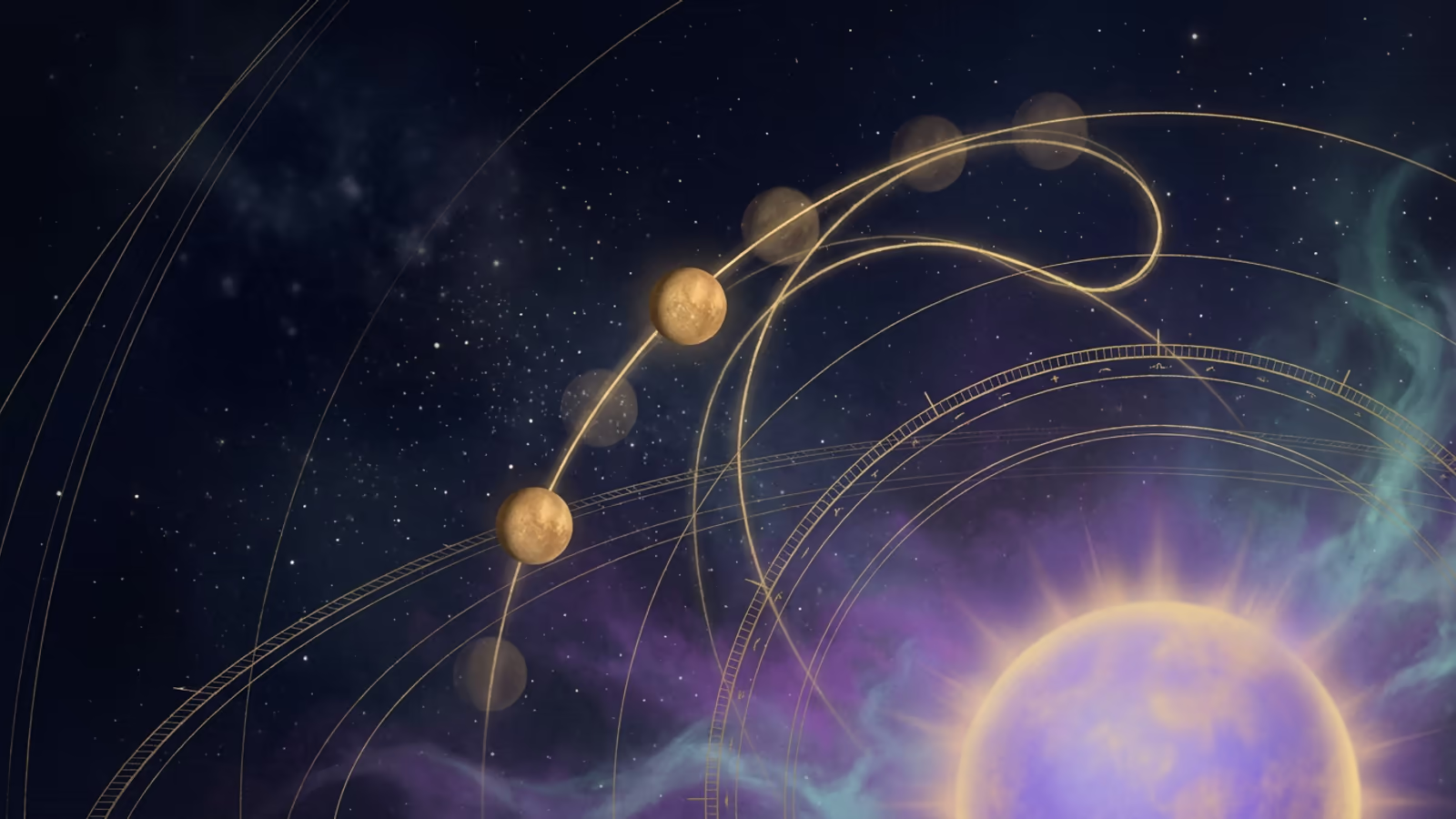
Three times a year the internet agrees that everything is breaking because Mercury is moving backwards across the sky. Mercury is not moving backwards. And yet you can build a genuinely sensible practice on this tradition, as long as you know what you’re actually doing.
In short: in 2026 Mercury goes retrograde three times: 26 February - 20 March (Pisces), 29 June - 23 July (Cancer) and 24 October - 13 November (Scorpio). All three in water signs, which is rare. Astronomically it’s an illusion of perspective: Mercury never changes direction, it simply overtakes Earth on the inner orbit. Astrological tradition ties the period to communication, contracts and technology, and practically it comes down to one piece of advice: this is a good time for reviewing and revising, a worse one for starting and signing.
Mercury retrograde dates in 2026
Three periods, all of them in water signs, a configuration that recurs roughly once a decade.
- 26 February - 20 March 2026: Mercury retrograde in Pisces. A sign of water and intuition: tradition associates this window with fog in communication, misunderstandings born of assumption, and old emotional matters resurfacing.
- 29 June - 23 July 2026: Mercury retrograde in Cancer. The theme of home, family and the past. Classically: conversations with relatives, returns to places, housing matters.
- 24 October - 13 November 2026: Mercury retrograde in Scorpio. The deepest of the three: truth, secrets, shared finances, whatever has gone unsaid. The only window still ahead of us this year.
Shadow periods. Astrologers also count the “shadow”: the time when Mercury crosses the same stretch of sky before and after the retrograde. For the autumn window that runs roughly 10 October to 29 November. Tradition says matters raised in the pre-retrograde shadow resolve in the shadow after it. Practically: if something stalls in mid-October, expect resolution only toward the end of November.
How long it lasts. Each retrograde runs about three weeks, three to four times a year. Mercury orbits the Sun in 88 days, so it “overtakes” Earth often, which is why it’s the planet that goes retrograde most frequently.
What’s actually happening in the sky
Honesty is owed here, because without it the rest of this article would be worthless.
Mercury does not slow, turn around or change direction. It orbits the Sun exactly as it always does, in the same direction, at the same speed.
Retrograde is an effect of perspective. Mercury is closer to the Sun than Earth is, so it moves faster, orbiting in 88 days against our 365. When Mercury catches up with us and passes on the inner track, from our vantage point it appears for a few weeks to move backwards against the fixed stars.
You know the effect from the motorway: you overtake a slower car and for a moment it looks as though it’s rolling backwards relative to the landscape behind it. It isn’t. You’re just going faster.
The effect is real and observable, you can see it through a telescope or trace it on a star chart. What’s not real is everything derived from it regarding an influence on your life: Mercury does not generate a field that corrupts hard drives or starts arguments.
Where the tradition comes from
The association isn’t accidental, it’s linguistic and mythological.
Mercury is the Roman counterpart of the Greek Hermes: messenger of the gods, patron of travellers, merchants, translators and, notably, thieves. All those domains share one thing: flow. Of messages, goods, meanings, money. In classical astrology the planet inherited its patron’s remit, so it governs communication, contracts, trade, transport and learning.
When the celestial body responsible for flow appears to turn back, tradition reads it as flow in the other direction: toward the past, toward correction, toward the unfinished. Hence the whole cluster of associations, from lost parcels to exes texting at two in the morning.
It’s a beautiful, internally consistent metaphor. And that is precisely what it is: a metaphor, not a mechanism.
Is there any evidence for this?
There isn’t. Worth saying plainly rather than hedging, because honesty is more interesting here than pretence.
No study demonstrates an increase in equipment failures, transport accidents or failed negotiations during Mercury retrograde periods. The impression that “something always breaks then” is produced by two well-documented mechanisms:
- Confirmation bias: once you know a retrograde is running, you notice and remember the mishaps, while the days without mishaps go unrecorded. During the other 40 weeks of the year equipment breaks at exactly the same rate, you just don’t have a label for it.
- The Barnum effect: general descriptions (“expect a misunderstanding in conversation”) fit nearly every week of nearly every person’s life.
So why write about it at all? Because astrological tradition, treated as a calendar of attention, does something useful regardless of whether planets exert any influence. Three times a year you get an external signal: slow down, read the contract twice, make a backup, get in touch with the person that thing was left unfinished with. That’s good advice in any week of the year. It’s just that in every other week nobody reminds you.
At Zorynthia we hold exactly to that framing: astronomy is fact, astrology is a language for reflection, and the decisions are yours.
What tradition says to avoid
The classic list, treat it as a checklist, not a prohibition.
- Signing important contracts. Not because a planet will void your signature, but because it’s a decent pretext to read the document once more. If a contract can’t wait three weeks, sign it. Especially where a flat or a job is concerned.
- Launching new projects. Tradition says what begins now will drag. Practically: use the time to sharpen your assumptions, since we usually launch too early anyway.
- Buying electronics and equipment. Here tradition and practice coincide by accident, gear bought on impulse really does disappoint more often.
- Sending messages while emotional. That one is universal advice, it’s just that hardly anyone applies it without a pretext.
- Travelling with no time buffer. Again: not because of a planet. Because a buffer is always useful.
One note of common sense: if the retrograde starts paralysing you, if you’re postponing a job interview or a doctor’s appointment because “it’s a bad time”, that’s a sign the tool has started governing instead of serving. Three weeks is too large a slice of a life to hand over to a metaphor.
What is worth doing: the four re-s
The constructive version of the same tradition, and considerably more interesting than a list of prohibitions. Retrograde is the season of the prefix re-.
Review. Go back to projects that stalled. Read notes from six months ago. Check the subscriptions paying for themselves. It’s the best moment for the tidying nobody gets to, because it’s never urgent.
Revise. The unfinished things: your CV, your portfolio, documentation, the resignation letter written in anger and never sent. Retrograde favours revising over creating, which is good, because revising is usually what falls out of the calendar.
Reconnect. With people where something was left hanging. Not with exes out of longing, with people something went unsaid with. Scorpio (the autumn 2026 retrograde) particularly favours the conversations you’ve been putting off because they’re uncomfortable.
Rest. Three weeks a year without the ambition to speed everything up is not a loss. It’s breath, recovered.
Mercury retrograde and the zodiac signs
The autumn 2026 retrograde (24 October - 13 November) takes place in Scorpio, the sign of truth, depth and what goes unspoken. Briefly, sign by sign, in the traditional reading:
- Aries: shared finances and obligations resurface. A good time to tidy up settlements, a bad one for new debt.
- Taurus: the emphasis falls on one-to-one relationships. The conversation you’ve been postponing for months will ripen now.
- Gemini: Mercury rules your sign, so you feel this window most sharply. Daily routine and health call for review, not revolution.
- Cancer: creativity, children, matters of the heart come back for reconsideration. An old project may revive.
- Leo: home, family, roots. Conversations with parents or housing decisions require patience.
- Virgo: the second sign ruled by Mercury. Communication, documents, transport, read everything twice, especially what you wrote yourself.
- Libra: personal finances and self-worth. A good moment to revise the budget, a bad one for large purchases.
- Scorpio: the retrograde happens in your sign, so it concerns identity. Classically: rethinking how you present yourself and what you actually want.
- Sagittarius: the unconscious and the unspoken. Dreams, intuition, closed matters. A more inward than outward period.
- Capricorn: friendships, groups, long-term plans. Someone from the past may return with a proposal.
- Aquarius: career and public image. Professional conversations that stalled come back.
- Pisces: travel, study, worldview. A good time to finish the course you abandoned.
A more detailed version for your own sign is in the weekly horoscope, which accounts for current planetary positions, Mercury included.
How to use the period in practice
Instead of waiting for something to break, turn those three weeks into a structured review. Three questions, one per week:
- Week one: what’s unfinished? List everything left hanging over the past six months, projects, conversations, decisions. No judging, just the list.
- Week two: what still matters? Most items on the list will turn out to be obsolete. That’s good news, crossing them off is half the work.
- Week three: what am I closing by the end of November? Pick two things. Not five.
If you want to add a symbolic layer to that, two ready-made questions work well:
- For the cards: “What am I trying to close without admitting it yet?”, the three-card spread handles this subject well, because the Past position points at the root of the matter.
- For the stars: “What am I meant to return to in this period before moving on?”
See what’s happening in the sky right now
At Zorynthia the astrological layer isn’t decoration, every reading includes a Sky Chart with current planetary positions and the Moon phase, so you see what’s actually happening at the moment you ask, rather than a generic description of the month.
- Ask the stars in your own words, you get the Essence, the Sky Chart, energy and emotion indicators, and concrete do/avoid guidance
- Up to three follow-up questions per reading, if you want to narrow something down
- Daily, weekly and monthly horoscopes for your sign
- 5 tokens to start, no credit card
→ Ask the stars about this period
Don’t want an account? We send the weekly horoscope by email for free, a short summary for all twelve signs, every Monday morning. Sign up on the home page, one field, no registration.
FAQ
When is Mercury retrograde in 2026? Three times: 26 February - 20 March (in Pisces), 29 June - 23 July (in Cancer) and 24 October - 13 November (in Scorpio). All three in water signs, which is an uncommon configuration. Counting the shadow periods, the autumn window stretches roughly from 10 October to 29 November.
Does Mercury really move backwards in the sky? No. It’s an illusion of perspective: Mercury orbits the Sun faster than Earth does (88 days against 365), so when it overtakes us on the inner orbit, from our vantage point it appears for a few weeks to move backwards against the stars. You see the same effect overtaking a car on the motorway.
How long does Mercury retrograde last? About three weeks, three to four times a year. Mercury goes retrograde more often than any other planet because it has the shortest orbital period.
What shouldn’t you do during Mercury retrograde? Tradition advises against signing important contracts, launching new projects, buying electronics and sending messages while emotional. Treat that as a checklist, not a prohibition, if a job offer or a tenancy agreement can’t wait three weeks, don’t make it wait.
Is there scientific evidence for the effects of Mercury retrograde? No. No study shows an increase in failures, accidents or misunderstandings during these periods. The impression that “something always breaks then” is explained by confirmation bias and the Barnum effect. The value of the tradition lies in working as a calendar of attention, three times a year it prompts a review of matters nobody would otherwise think to revisit.
Which zodiac sign feels Mercury retrograde most strongly? Traditionally Gemini and Virgo, since both are ruled by Mercury. On top of that, the sign the retrograde actually takes place in feels it strongly: in autumn 2026 that’s Scorpio.
Does Mercury retrograde affect relationships? In astrological tradition it’s a period of returns: of old conversations, unresolved matters, sometimes former partners. The practical version of the same thought holds regardless of astrology: it’s a good moment to finish a conversation you’d been postponing, and a bad moment to make final decisions under a resurgence of feeling.
Mercury isn’t turning around and isn’t breaking your laptop. But three times a year you’re handed cultural permission to slow down, go through the backlog, and get in touch with someone a matter was left half-open with.
If you need a planet for that, fine, let it be a planet. What matters is that the review actually happens.