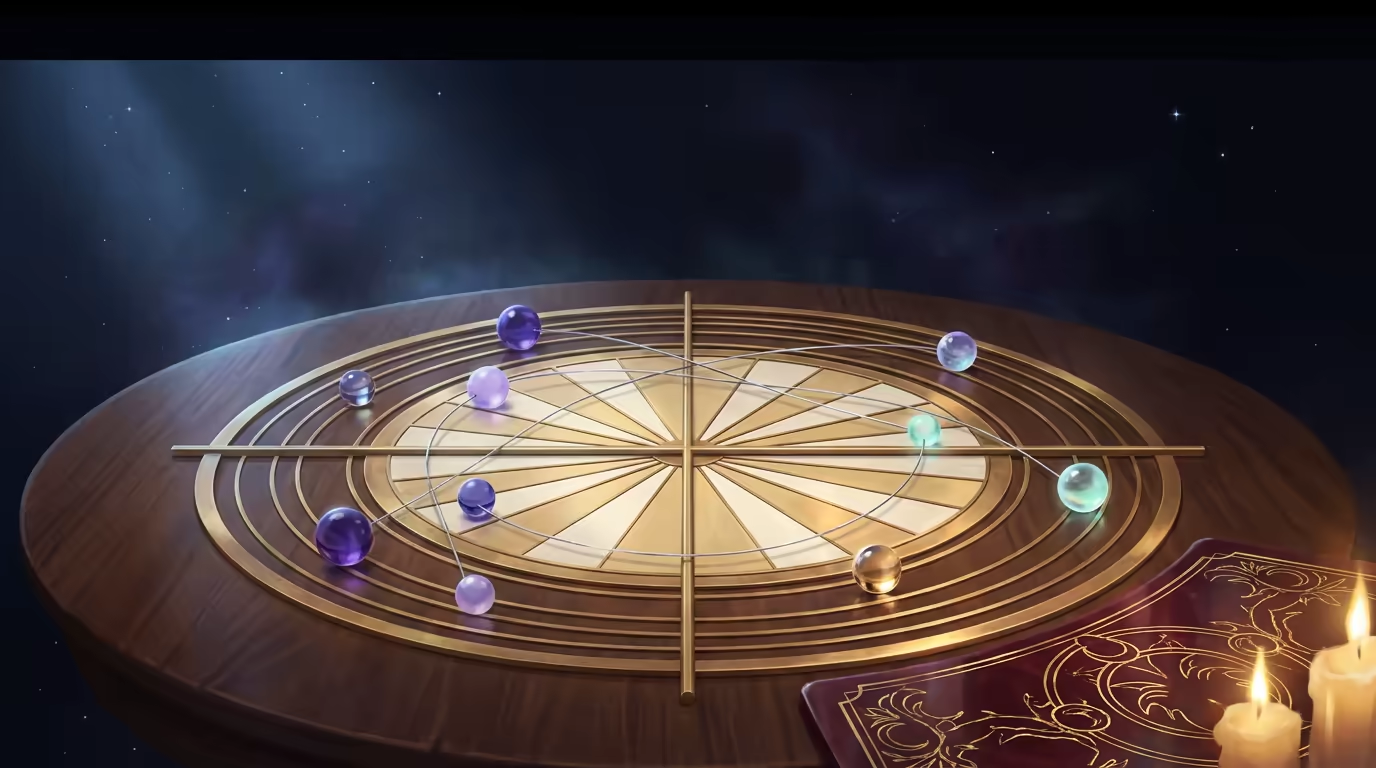
Astroline sounds a bit like the name of a secret cable between a person and the cosmos. In practice it is a simple term for something astrology has used for a long time: lines of meaning that connect points on your sky chart. Planets, axes, houses and aspects form a network of relations. Each line tells a different story about how your energy moves.
In Zorynthia these connections are visible directly. In tarot spreads an astroline links a card with a planet or a sign. In the astrology section it links planets with each other and with houses. This is not a term from academic astronomy. It is a friendly name for the structure you already look at in a horoscope: geometric relations on the zodiac wheel.
In short: an astroline is a way to view a birth chart as a network of connections, not a set of isolated points. Every line between planets, axes and houses tells a concrete story about tension, support or flow of energy. It is not a scientific category, but astrological language and a tool for self-reflection. In Zorynthia astrolines connect tarot cards with planets and help form more precise questions in spreads.
1. What exactly is an astroline
Classical astrology talks about aspects, axes and houses. In Zorynthia we call these collectively astrolines, because they all describe relations rather than single objects. An astroline is therefore:
- a line connecting two planets in an aspect
- a line between a planet and a horoscope axis
- a line between a tarot card and a sign or planet in an interpretation
From the astronomy side the facts are simple: planets orbit, Earth also orbits. Aspects are just a way to measure angles between them from the observer on Earth. An astroline does not exist physically in space. It exists as a schematic in the mind, a map that helps order a lot of information.
In a natal chart an astroline suggests, for example: here Mars is in tension with the Moon, here Venus cooperates with Jupiter, here the Sun sits near the Midheaven. Each of those lines is a question to yourself that you can later expand in a tarot spread.
2. Astroline and the sky chart: where to actually see it
If you look at a circular chart, you see zodiac signs on the outside, planet symbols in the center, and a dense web of lines crossing the wheel. That web is the visual astroline. Each line has an angle, a color or a drawing style, depending on the program or app.
In Zorynthia these connections appear in two places. First, in the questions about your birth chart, where you can ask about a specific relation, for example the Sun opposite Saturn. Second, in the tarot section, where in some spreads AI matches cards to the planets or signs in your chart and shows the line between them.
Practically, an astroline is just information: what works with what. Without birth date and place there is no individual chart. Without looking at the lines the chart remains a set of independent descriptions, hard to weave into a whole.
3. Planets as nodes of astrolines
For an astroline to make sense it needs points to connect. In astrology those points are primarily planets. In simple terms each planet represents a different psychological function or area of experience:
- Sun: sense of self, the direction you shine
- Moon: emotions, habits, need for security
- Mercury: thinking, communication, learning
- Venus: relationships, pleasure, taste
- Mars: action, energy, assertiveness
- Jupiter: growth, expansion, beliefs
- Saturn: limits, duties, structures
- Uranus, Neptune, Pluto: long generational processes and deep transformation
An astroline between two planets therefore says: these two functions in your life are talking to each other, supporting each other or clashing. For example a line between Venus and Saturn can describe a serious approach to relationships, and also fear of closeness. This is not a medical or psychological diagnosis, but a metaphor to use as a mirror.
If you also work with tarot, you will quickly notice bridges between planets and cards. In the article about the Fool card it shows how that card links to Uranus. Those connections are also astrolines, described in another symbolic language.
4. Zodiac signs as the stage for lines
A planet without a sign is like an actor without a set. A zodiac sign is not an astronomical constellation in the technical sense, but twelve equal 30 degree segments of the ecliptic used in astrology. Astroline always runs through a sign or connects planets in different signs.
If Mars makes a line to the Moon, but one sits in Leo and the other in Scorpio, the story is different than Mars in Virgo and Moon in Gemini. Signs add a tone, a way the energy expresses itself:
- fire signs: Aries, Leo, Sagittarius
- earth signs: Taurus, Virgo, Capricorn
- air signs: Gemini, Libra, Aquarius
- water signs: Cancer, Scorpio, Pisces
Astrolines through signs show where energy flows easily and where it requires more effort. In tarot this appears similarly, when you lay out a three-card spread and two cards show a similar tone while the third clearly opposes them.
5. Horoscope houses: where the astroline acts
Planets and signs say what and how. Houses add the third question, where. The twelve houses are life areas: relationships, work, family, friendships, hidden matters. An astroline between planets in specific houses points to which domains weave together most strongly.
Examples:
- a line between a planet in the 2nd house, resources and self-worth, and a planet in the 8th house, shared finances and crises, can direct attention to sharing and dependence
- a line between the 5th house, creativity and children, and the 10th house, career and visibility, often raises questions about creative work
In Zorynthia ask first about the monthly climate in horoscopes, then go to the astrology section and request AI to discuss one chosen line, for example “what does the line between my Moon and Saturn in houses 4 and 10 say”. This remains an interpretive exercise, not instruction for life.
6. Aspects: types of astrolines and their “temperature”
Classical astrology distinguishes major aspects, that is angles between planets. Astroline then takes on different “temperatures”:
- conjunction around 0 degrees: merging of energies, intensification
- sextile around 60 degrees: mild support, opportunity
- trine around 120 degrees: easy flow, natural talent
- square around 90 degrees: tension, challenge
- opposition around 180 degrees: polarization, tug of war
Astrology programs often color these lines differently. In Zorynthia we focus on content rather than graphics. AI interpretations give a description of the quality of the relation, not a table of angles. If needed, ask for details, for example “how does Mars square Moon work in my chart”.
Astroline based on aspects pairs well with tarot. In the article about the Celtic Cross it shows how card positions form tensions and supports between each other. It is the same approach: look at relations, not single symbols.
7. Horoscope axes: the most important background lines
Beyond planets and aspects there are horoscope axes. These four key points form two primary astrolines:
- Ascendant - Descendant: the line “self and others”
- Imum Coeli - Midheaven: the line “private and public”
These lines are not planets, but geometric points calculated from birth time and place. In practice they act as the background for everything else. A planet conjunct the Ascendant or Midheaven becomes highly visible, because it sits on a main axis.
In Zorynthia ask AI to focus only on these axes. For example: “describe the line between my Ascendant in Libra and the Sun in Aries”. That kind of astroline often shows inner pull between how you present yourself and how you feel inside.
8. Astroline in Zorynthia: how to use it
Astroline in our app is not a separate module, but a working method applied to what is already there. Use it in three simple ways.
First, in online tarot choose a spread that links to astrology, for example a lunar cycle spread. AI will pull your Moon information and show how the line between a card and a planet can prompt a question.
Second, in the astrology section ask directly about relations: not “what does my Mars in Virgo mean”, but “what does the line between my Mars and Venus say”. That yields a description of dynamics, not a single trait.
Third, if you use an account, your data saves so you do not repeat it every time. Registration is simple, go to create an account on Zorynthia. You can also use the app anonymously, but then the chart will not be saved.
An extra practice we recommend: before asking a question note a brief context, for example the date of a meeting, main worries and expectations. These short frames help AI produce an astroline description tailored to the situation.
9. Astroline and tarot: bridges between systems
Astrology and tarot developed separately. Modern practice often combines them. Astroline is one such bridge. For example:
- Mars often connects with the Knight of Wands or the energy of the Wands suit
- Venus associates with the Empress and with the Two of Cups
- Saturn resonates with Justice or with the World card, depending on the school
In the article on how tarot affects life it explains that the most interesting moments happen when symbols start talking to each other. An astroline between a spread card and a planet in a chart is precisely that conversation.
Practical example: draw the Tower in a daily spread. In Zorynthia AI may add that the Tower is often linked to Mars, and that today Mars forms a tension with your Moon. That does not mean “something will definitely fall apart”. It invites a question: where do I feel an impulse for sudden change today, and how do I want to respond.
In practice track which card and which planet appear most often in your daily notes. If the same relation repeats across several spreads, that is a signal for deeper work than a single interaction.
10. How to track your astrolines on your own
You do not need the full theory to work with astrolines. Adopt one habit: look at relations. Practical steps:
- Open your chart in any tool or in Zorynthia.
- Instead of reading each planet separately, pick one line that caught your attention, for example Sun square Saturn.
- Note the signs and houses of those planets.
- Ask one concrete question, for example “how do I react to limits” or “when do I say no to myself”.
- If you use tarot, do a small three-card spread specifically for that question.
This method does not provide ready-made answers. It creates space for an inner conversation. An astroline is a thread to pull, to see what else is woven into it.
Practical note for keeping observations: write the date, brief emotional notes and any concrete events. After a month compare entries and check if the line showed repeatable patterns. This is the simplest way to move from symbols to observation.
11. Safety and limits: what an astroline can and cannot do
Astrology is not a science in the strict sense. Astrolines lack confirmation in astronomical or psychological research. They are a language of symbols. In Zorynthia we treat that language as a tool for self-reflection and imaginative play, not as a system for predicting the future.
A few simple rules:
- do not use astroline interpretations as a basis for medical, legal or financial decisions
- if an interpretation worries you, pause, talk with someone you trust or consult a professional
- you can always limit the data you provide to the app, and check how it is protected in our privacy policy and terms of service
If you prefer a light entry, start with a simple free online tarot reading and add the astrological layer later.
12. Astroline and AI: how Zorynthia calculates it
Technically an astroline in Zorynthia arises from three elements.
First, from the data you provide: date, time, place of birth. From these the positions of planets and axes on the zodiac wheel are calculated. We use astronomical algorithms, the same coordinates appear in standard ephemerides.
Second, from traditional astrological rules: which angles count as aspects, how houses work, which planets relate to which signs. That is not science, but a symbolic system. A similar mechanism on the tarot side is described in Tarot AI: how it works.
Third, from the interpretive AI layer that assembles these blocks into text. The algorithm does not “know” what will happen in your life. It arranges patterns into a coherent narrative. Your role is to decide what to take from that narrative and what to leave aside.
Practical notes for working with AI: ask short, specific questions, include context and state whether you want the interpretation general, practical or creative. That produces more precise and usable answers.
13. When an astroline is most useful
Astroline is especially helpful at moments of transition. For example:
- before an important conversation, to check how Mercury and Saturn connect in your chart, then do a small tarot spread for today
- during a tense period, when charts mention retrogrades and aspects, and you want to see how those specifics touch your lines
- for longer reflection, pick one astroline per month and explore it in a journal
You do not need to follow everything at once. One line, one question, one small spread. Small steps usually work better than trying to master the whole chart in one evening.
Q: Can an astroline predict the future?
A: No. An astroline describes relations between symbols in your chart. From them you can draw metaphors, scenarios and questions, but not specific events with date and time. It is a tool for reflection, not a forecasting system.
Q: Can I work with an astroline without an exact birth time?
A: Partly. Planetary positions in signs are usually determinable without an exact time, so aspects between planets still apply. Houses and axes depend strongly on time. In Zorynthia you can then focus on lines between planets and leave houses open.
Q: Is an astroline consistent with astronomy?
A: Astronomy supplies the positional data used to compute a chart. The interpretation of lines, the meaning of signs and houses is astrological tradition, not science. The two fields operate alongside each other: not in conflict, but not methodologically identical.
Q: Can I work with a single astroline for a long time?
A: Yes. That is often clearer than jumping around the whole chart. Pick one relation that moves you, for example Sun opposite Moon, and return to it in tarot, journaling and conversations.
Q: Do I need to know all aspects to use Zorynthia?
A: No. The app calculates angles for you and translates them into plain language. Learn aspect names gradually if you want, but it is not required for an astroline to be useful as inspiration.
Astroline is only a word, but behind it sits a simple gesture: instead of looking at isolated points, look at what connects them. In a chart that means planets, signs, houses and axes. In tarot that means cards and their positions in a spread. In life it means choices, relationships and experiences.
If desired, Zorynthia can make those lines more visible. Once as a chart description, once as a tarot spread, once as a calm weekly horoscope. Symbols do not have to tell you what to do. They can help you ask slightly better questions.